From Hadoop to AI Pipelines: 9 Breakthroughs That Redefined Data Engineering
Twenty years ago, “data engineering” wasn’t really a job title. Database administrators, ETL developers, or backend engineers who drew the short straw moved data around. Pipelines ran as nightly batch jobs that broke quietly, and changing a single report could take a week.
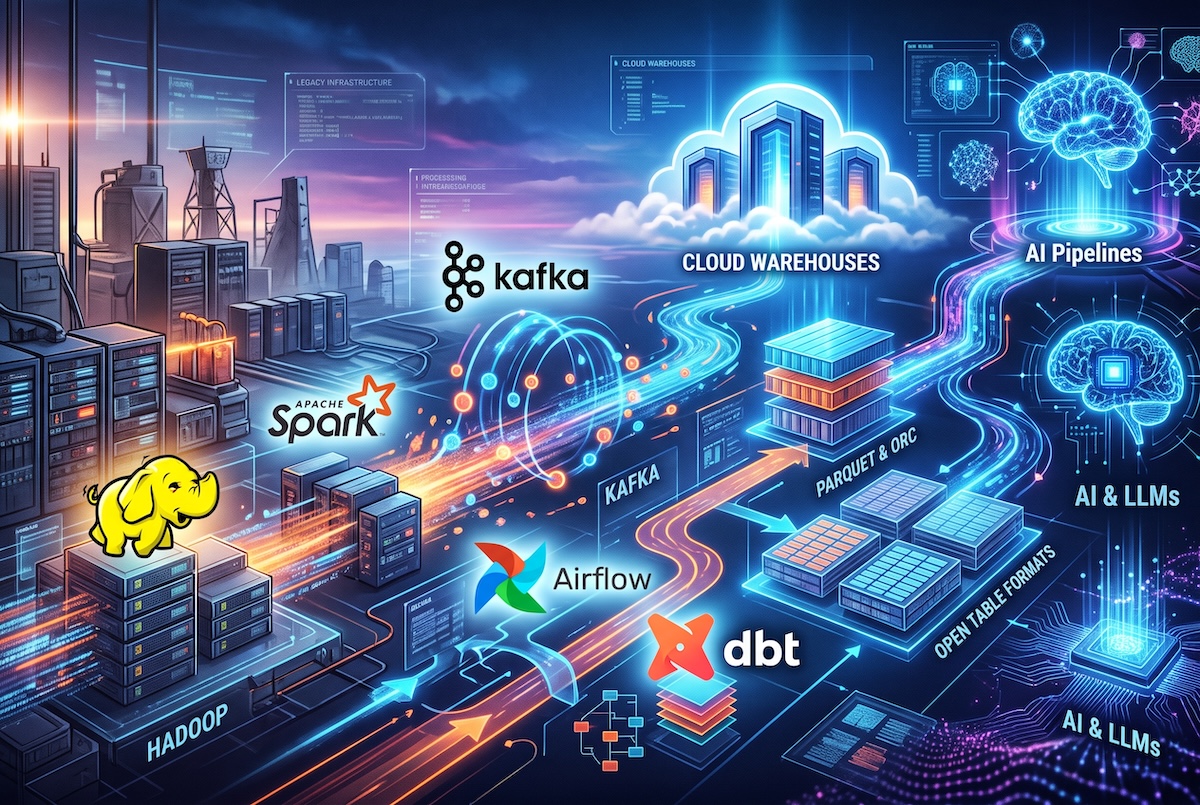
That world is gone. Today, data engineering is one of tech's most important disciplines, and the stack behind it looks nothing like it did in 2005. That shift didn’t happen gradually. A handful of technologies forced the industry to rethink how data should be stored, moved, processed, and trusted.
Here are the nine that mattered most and why each one still shapes the way data teams work today.
Key takeaways
Data engineering evolved from expensive, on-premises batch systems to cheap, elastic, cloud-native platforms.
The biggest shifts were about separating concerns: storage from compute, transformation from ingestion, and code from infrastructure.
Open formats and open-source tools gave teams freedom from vendor lock-in.
AI is now the newest force reshaping both what pipelines feed and how they’re built.
1. Hadoop and MapReduce: Big Data Becomes Possible
Before Hadoop, storing and processing massive datasets meant buying very expensive, specialised hardware. Hadoop, which grew out of research papers Google published on its file system and MapReduce model, flipped that idea on its head around 2006.
Instead of one powerful machine, Hadoop spread data and computation across clusters of cheap commodity servers. The Hadoop Distributed File System (HDFS) stored the data, and MapReduce processed it in parallel.
Why it changed everything: Hadoop proved that companies of almost any size could store and analyse data at a scale previously reserved for tech giants. It also launched an entire ecosystem, including Hive, Pig, and HBase, and gave birth to the term “big data” as most people know it.
Its legacy today: Few teams start new projects on MapReduce now. But the core idea of distributed, horizontally scalable processing sits underneath nearly every modern data platform.
2. Apache Spark: Making Big Data Fast
MapReduce worked, but it was slow and painful to program. Every step wrote results to disk, and even simple jobs required lots of boilerplate code.
Apache Spark, which started at UC Berkeley’s AMPLab, fixed both problems. It kept data in memory between processing steps, making many workloads dramatically faster, and offered friendly APIs in Python, Scala, Java, SQL, and R.
Why it changed everything: Spark unified batch processing, SQL queries, streaming, and machine learning in one engine. For the first time, data engineers and data scientists could work in the same framework instead of throwing code over the wall to each other.
Its legacy today: Spark remains a workhorse for large-scale transformation and is the foundation of platforms like Databricks.
3. Apache Kafka: Data Starts Moving in Real Time
For years, data moved in batches: once a night, once an hour, maybe every fifteen minutes if you were ambitious. Apache Kafka, created at LinkedIn and open-sourced in 2011, changed that expectation.
Kafka treats data as a continuous stream of events stored in a durable, distributed log. Applications publish events, and any number of other systems can subscribe and react to them almost instantly.
Why it changed everything: Kafka turned data from something you collected and processed later into something that flows through a business in real time. Fraud detection, live dashboards, ride-hailing location updates, and instant recommendations all depend on this kind of streaming backbone.
Its legacy today: Event streaming is now a standard architecture pattern, and tools like Apache Flink build on it to process streams with low latency.
4. Cloud Data Warehouses: Separating Storage From Compute
Traditional data warehouses were expensive, rigid appliances. You bought capacity up front, and scaling meant a long procurement cycle.
Cloud warehouses like Amazon Redshift, Google BigQuery, and Snowflake rewrote the economics. Snowflake and BigQuery in particular popularised a crucial design choice: separating storage from compute, so each can scale independently and you pay only for what you use.
Why it changed everything: Suddenly, a five-person startup could query billions of rows without hiring a database team or buying hardware. Analysts could spin up compute for a heavy query and shut it down minutes later.
Its legacy today: This architecture made it cheap enough to load raw data first and transform it later, which set the stage for the next big shift.

5. Columnar File Formats (Parquet and ORC): Smarter Storage
This one is less glamorous, but its impact is enormous. Row-based formats like CSV store data the way a spreadsheet looks: one full record after another. Analytical queries, however, usually read a few columns across millions of rows.
Columnar formats like Apache Parquet and ORC store data column by column. That means queries can skip irrelevant columns entirely, and similar values compress extremely well.
Why it changed everything: Columnar storage slashed both storage costs and query times. It also made data lakes on cheap object storage (like Amazon S3) genuinely useful for analytics, not just as dumping grounds.
Its legacy today: Parquet is effectively the default file format for analytical data across the industry.
6. Apache Airflow: Pipelines as Code
As pipelines multiplied, tracking what ran when and what depended on what became a nightmare. Many teams relied on cron jobs and hope.
Apache Airflow, built at Airbnb and later donated to the Apache Software Foundation, introduced a clean idea: define workflows as code. Pipelines are written in Python as directed acyclic graphs (DAGs), with dependencies, schedules, retries, and alerts built in.
Why it changed everything: Orchestration became versionable, testable, and reviewable like any other software. Data engineering started to look much more like software engineering.
Its legacy today: Airflow remains widely used, and newer orchestrators such as Dagster and Prefect build on the same “pipelines as code” philosophy with a stronger focus on data assets and observability.
7. dbt: The Rise of ELT and Analytics Engineering
Once cloud warehouses made storage and compute cheap, the old ETL pattern (extract, transform, then load) started to make less sense. Why transform data on a separate server when the warehouse could do it faster?
dbt (data build tool) became the face of this new ELT approach. It lets teams write transformations as SQL models, then adds software engineering practices on top: version control, testing, documentation, and dependency management.
Why it changed everything: dbt gave analysts who knew SQL the power to build production-grade data models without waiting on engineers. It essentially created a new role, the analytics engineer, and became a cornerstone of what people call the “modern data stack.”
Its legacy today: Treating data transformation as tested, documented code is now considered best practice almost everywhere.
8. Open Table Formats and the Lakehouse: The Best of Both Worlds
Data lakes were cheap and flexible but messy. Warehouses were reliable and fast but more expensive and closed. Teams often ran both and copied data between them.
Open table formats, including Apache Iceberg (originally from Netflix), Delta Lake (from Databricks), and Apache Hudi (from Uber), solved this. They add a metadata layer on top of files like Parquet, bringing warehouse-style features to the data lake: ACID transactions, schema evolution, time travel, and efficient updates and deletes.
Why it changed everything: This made the “lakehouse” possible: one copy of data in open formats on cheap storage, queryable by many different engines. Teams can use Spark, Trino, Snowflake, or other tools on the same tables without locking themselves into a single vendor.
Its legacy today: Open table formats, especially Iceberg, have become a central battleground for major data platforms, and interoperability is now a key buying criterion.
9. AI and Large Language Models: The Newest Disruption
The latest force reshaping data engineering is artificial intelligence, and it’s working on two fronts.
First, AI is a new data consumer. Machine learning models and LLM applications need clean, well-governed, fresh data, plus new kinds of infrastructure like vector databases, embedding pipelines, and retrieval systems for unstructured content such as documents and images.
Second, AI is becoming a pipeline builder. Coding assistants can generate SQL, write transformation logic, document tables, and help debug broken jobs. Tasks that took hours now take minutes.
Why it’s changing everything: Data quality has never mattered more, because a model is only as good as the data feeding it. At the same time, data engineers' day-to-day work is shifting from writing boilerplate to architecture, governance, and reliability.
Where it’s heading: Expect data platforms to treat unstructured data as a first-class citizen and for AI agents to take on more routine pipeline maintenance, with humans focused on design and oversight.
The Bigger Pattern
Look across these nine technologies, and a clear story appears. Each one removed a bottleneck:
Technology | Bottleneck it removed. |
|---|---|
Hadoop | Expensive hardware for big data |
Spark | Slow, hard-to-write batch jobs |
Kafka | Waiting hours for fresh data |
Cloud warehouses | Fixed, costly capacity |
Parquet/ORC | Inefficient storage and scans |
Airflow | Fragile, untracked scheduling |
dbt | Transformations locked away from analysts |
Open table formats | Duplicate lakes and warehouses |
AI/LLMs | Manual, repetitive pipeline work |
The common thread is accessibility. Every breakthrough made it cheaper, faster, or easier for more people to work with more data. That trend is far from over.
Frequently Asked Questions
What is the most important technology in data engineering history?
There’s no single winner, but Hadoop is often credited with starting the big data era, while cloud data warehouses arguably had the biggest impact on how most companies work with data today.
Is Hadoop still used in data engineering?
Some organisations still run Hadoop clusters, mostly for legacy workloads. New projects typically use cloud object storage, Spark, and lakehouse architectures instead.
What is the difference between ETL and ELT?
ETL transforms data before loading it into a warehouse. ELT loads raw data first and transforms it inside the warehouse, an approach made practical by cheap, scalable cloud compute and tools like dbt.
What is a data lakehouse?
A lakehouse combines the low-cost, flexible storage of a data lake with the reliability and performance features of a data warehouse, usually using open table formats such as Apache Iceberg or Delta Lake.
How is AI changing data engineering?
AI increases demand for high-quality data and new infrastructure like vector databases, while AI coding tools automate parts of building, documenting, and maintaining pipelines.
Final Thoughts
Data engineering went from a back-office chore to the foundation of analytics, products, and AI in less than two decades. The nine technologies above didn’t just add new tools to the toolbox; they changed what was possible and who could do it.
If you’re building in this space, the lesson is simple: the next breakthrough will probably come from whoever removes the next bottleneck. What do you think it will be? Share your take in the comments below.