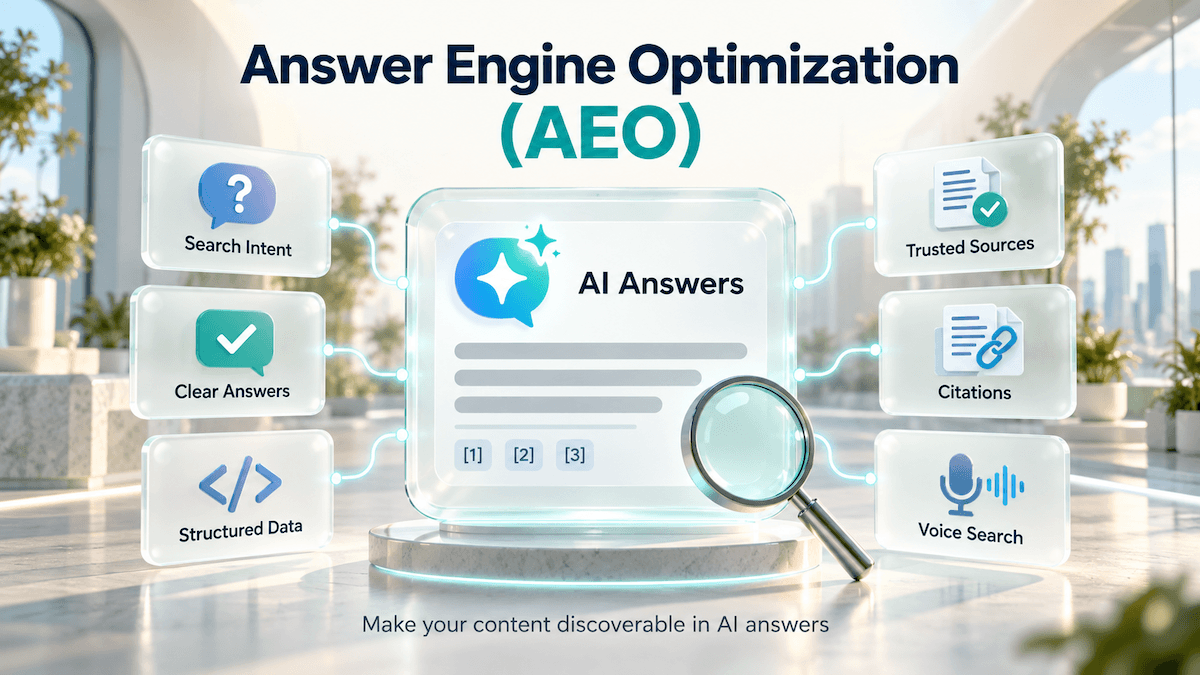
Ask someone how they found the last tool they signed up for, and the answer is changing. It used to be “I Googled it.” Now you’ll often hear “ChatGPT recommended it." “Perplexity pointed me to it,” or “it showed up in the AI summary at the top of Google.”
That shift matters. When an AI system answers a question directly, users often never see a list of ten blue links. They see one answer, sometimes with a handful of cited sources, and they act on it. If your brand isn’t part of that answer, you weren’t just ranked lower. You weren’t in the conversation at all.
This is the problem answer engine optimization (AEO) sets out to solve.
What Is Answer Engine Optimization?
Answer engine optimization is the practice of structuring your content, brand information, and online presence so that AI-powered answer engines can understand it, trust it, and include it in the answers they generate.
“Answer engines” covers a growing group of tools:
AI assistants such as ChatGPT, Claude, Gemini, and Copilot
AI search tools such as Perplexity
AI-generated summaries inside traditional search engines, such as Google’s AI Overviews
Voice assistants that read out a single answer
You’ll also see the terms generative engine optimization (GEO) and AI search optimization. The labels overlap heavily. They all describe the same goal: being the source an AI chooses to quote, summarize or recommend.
How AEO Differs From Traditional SEO
AEO doesn’t replace SEO. Most answer engines still lean on search indexes and well-ranked pages to find information, so solid SEO remains the foundation. But the target is different.
Traditional SEO | Answer Engine Optimization | |
|---|---|---|
Goal | Rank a page high in search results. | Get your brand or content included in the AI’s answer. |
Unit of success | A click to your website | A mention, citation, or recommendation |
What gets evaluated | Pages | Passages, facts, and entities |
Winning format | Comprehensive, keyword-relevant pages | Clear, direct, quotable answers backed by authority |
Competition | Ten spots on page one | Often one to five cited sources |
The biggest change is the last row. On a results page, being sixth still gets you some traffic. In an AI answer, there’s frequently no sixth place.

Why AEO Matters for Your Brand Right Now
Visibility is moving upstream.
More discovery now happens before a user reaches any website. Someone comparing project management tools, looking for a real estate platform or asking which payment gateway works best in their country may get a shortlist straight from an AI. The brands on that shortlist get considered. The rest don’t.
Zero-click doesn’t mean zero value.
A common worry is that AI answers steal traffic. Some informational traffic does disappear. But a citation in an AI answer acts as a strong recommendation, and visitors who click through tend to be further along in their decision. Being named, even without a click, builds recognition that pays off later when someone searches your brand directly.
AI shapes how your brand is described.
If you don’t give answer engines clear, consistent information about who you are and what you do, they’ll fill the gaps with whatever they can find: an old review, a competitor’s comparison page, or an outdated directory listing. AEO is partly about controlling your own narrative.
Early movers have an edge
Plenty of businesses still treat AI visibility as an afterthought. Smaller brands and startups that structure their content well can earn citations alongside, or ahead of, much larger competitors, because answer engines reward clarity and relevance, not just size.
How Answer Engines Decide What to Cite
No AI company publishes a full recipe, but a few patterns show up consistently:
Direct relevance. Content that answers the exact question asked, in plain language, is easier to lift into a response.
Clarity and structure. Clear headings, short paragraphs, lists, and tables make it easy for a model to extract a specific passage.
Authority and corroboration. Brands mentioned across multiple trusted sources, such as reviews, news coverage, industry directories, and community discussions, look more credible than brands that only talk about themselves.
Freshness. For anything time-sensitive, recently updated content has the advantage.
Specificity. Concrete facts, numbers, definitions, and examples are more quotable than vague marketing language.
A Practical AEO Playbook
1. Answer real questions directly.
Find the questions your customers actually ask in sales calls, support tickets, community forums, and “People also ask” boxes. Then answer each one clearly in the first sentence or two of the relevant section before adding depth.
A weak opening: “In today’s fast-paced digital landscape, many businesses are exploring new solutions...”
A strong opening: “Answer engine optimization is the practice of making your content easy for AI tools to find, trust, and cite.”
2. Write in self-contained passages.
AI systems often pull a single paragraph rather than a whole page. Make each section make sense on its own. Name the subject instead of relying on “it” or “this” from three paragraphs earlier.
3. Use structure deliberately.
Descriptive H2 and H3 headings, question-based phrasing, numbered steps for processes, comparison tables for alternatives, and FAQ sections for common follow-ups help both readers and machines.
4. Add structured data.
Schema markup such as Organization, Product, FAQPage, HowTo, and Article helps search engines and AI systems understand what your content is and who is behind it. It isn’t a magic switch, but it removes ambiguity.
5. Define your brand as an entity
Make it unmistakable what your brand is, what it does, and who it serves. Keep your name, description, and key facts consistent across your website, social profiles, business listings, LinkedIn company page, and any knowledge bases. Inconsistent descriptions confuse AI models as much as they confuse people.
6. Earn mentions beyond your own site.
Answer engines look for corroboration. Get listed on relevant directories and launch platforms, contribute expert commentary to industry publications, collect genuine customer reviews, and take part in community discussions where your audience already gathers. Third-party mentions often carry more weight than anything you publish yourself.
7. Show real expertise.
Original data, case studies, firsthand experience, and named authors with genuine credentials make content more trustworthy and harder for competitors to replicate. Generic content that restates what’s already online gives an AI no reason to choose you.
8. Keep content current.
Review and update key pages regularly, especially pricing, features, comparisons, and anything with dates or statistics. Show a “last updated” date where it makes sense.
9. Don’t block the crawlers you want.
Check your robots.txt and site settings. Some sites unintentionally block AI crawlers or hide important content behind hard-to-read scripts. Decide deliberately which AI systems can access your content.
How to Measure AEO Success
AEO measurement is still maturing, but you can start with simple steps:
Test the questions yourself. Regularly ask major AI tools the questions your customers ask, and note whether your brand appears, how it’s described, and which sources it cites.
Watch referral traffic. Many analytics tools now show visits from AI platforms such as ChatGPT and Perplexity.
Track branded search. Growth in direct searches for your brand name can signal that AI mentions are building awareness.
Monitor brand mentions. Keep an eye on reviews, forums, and publications, since these feed what AI systems learn about you.
Consider dedicated tools. More platforms now track brand visibility across AI answer engines.
Common AEO Mistakes to Avoid
Stuffing keywords into content instead of answering questions clearly
Publishing thin, AI-generated content that adds nothing new
Letting outdated information sit on your site and across the web
Using different brand descriptions on every platform
Treating AEO as a one-time project rather than an ongoing practice
Abandoning SEO entirely, when answer engines still depend on it
The Bottom Line
Answer engine optimization is about being the clearest, most trustworthy answer to the questions your audience is asking, wherever they ask them. The brands that win won’t necessarily be the biggest. They’ll be the ones that explain themselves well, show genuine expertise, and get mentioned in the right places.
Start small: pick your ten most important customer questions, answer each one clearly on your site, tidy up your brand information everywhere it appears, and test what AI tools say about you each month. The sooner you begin, the more likely your brand is to be part of the answer.
Frequently Asked Questions
What is answer engine optimization in simple terms?
It’s the practice of making your content and brand information easy for AI tools like ChatGPT, Perplexity, and Google’s AI Overviews to find, understand, and include in their answers.
Is AEO the same as GEO?
They’re closely related and often used interchangeably. Both focus on earning visibility in AI-generated answers, not just in traditional search rankings.
Does AEO replace SEO?
No. Answer engines still rely heavily on search indexes and authoritative web pages. Strong SEO is the foundation that AEO builds on.
How long does AEO take to show results?
It varies. Clearer content and structured data can help fairly quickly once pages are recrawled, while building authority through third-party mentions takes months of consistent effort.
Can small businesses compete in AI answers?
Yes. Answer engines reward relevance, clarity, and credibility. A focused small brand that answers niche questions well can be cited ahead of larger competitors.