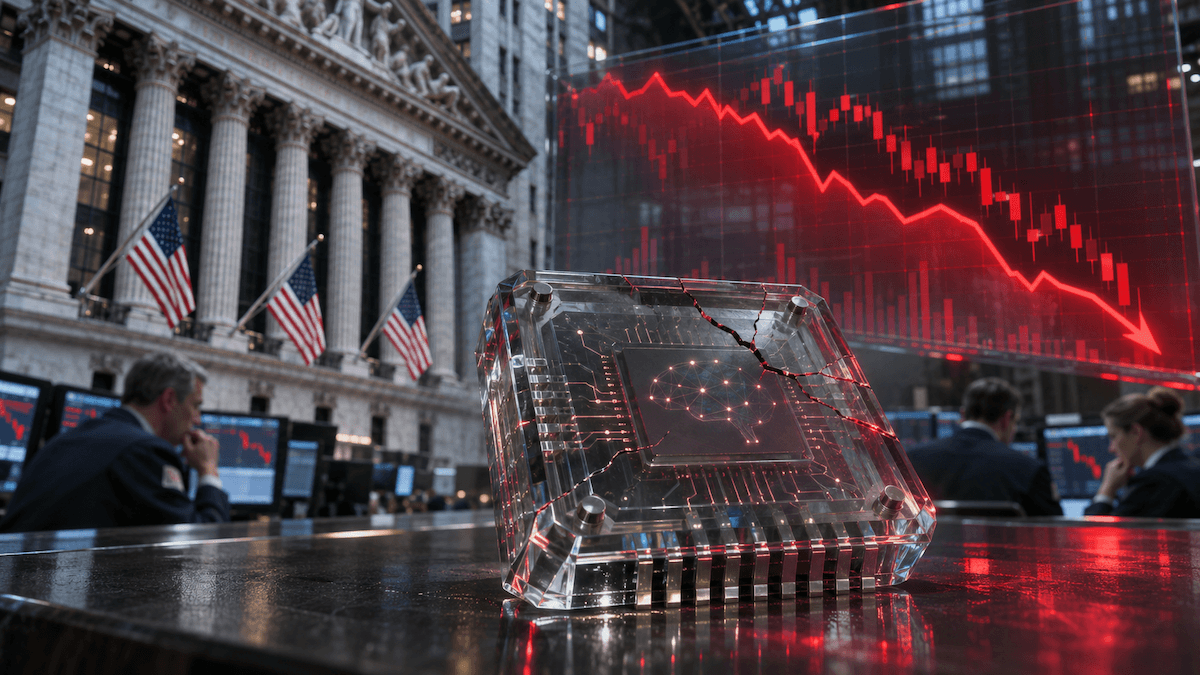
The S&P 500 lost $2.5 trillion as chip stocks crashed and midterm results fueled fears of AI regulation. Here’s what happened and what it means for founders.
Key takeaways
The S&P 500 fell 4%, wiping out more than $2.5 trillion in value, while the Nasdaq 100 dropped over 6%. Both indexes had their worst session since April 2025, when tariff announcements shook markets.
The Philadelphia semiconductor index sank 11%, on course for its worst day since the March 2020 pandemic crash.
Two forces collided: disappointing chip earnings and midterm results that put AI data center critics into office.
What happened on Thursday?
The artificial intelligence trade, the engine behind most of Wall Street’s gains over the past two years, hit a wall on November 5, 2026. The broader Nasdaq Composite slid more than 5% and entered correction territory, a decline of at least 10% from its recent peak. The Dow shed roughly 1,600 points, or 3%, with Nvidia the single biggest drag after falling 9%, its steepest one-day drop since April 2025.
The pain was sharpest in the hardware that powers AI. SanDisk plunged 20%, Western Digital and AMD each lost 15%, and Seagate and Micron fell about 13%. An ETF tracking memory chipmakers dropped 15%. Even old-economy suppliers to the AI buildout weren’t spared: Cisco and Caterpillar, both major vendors to AI data centers, slipped around 5%.
Trigger #1: Chip earnings that didn’t impress
The selling began after Qualcomm and Arm Holdings released quarterly results Wednesday night that investors largely saw as mixed. Both stocks fell about 12%, among the Nasdaq's worst performers.
This comes as the market is already on edge. In October alone, investors erased an estimated $2 trillion from the Nasdaq-100 as they questioned whether massive AI spending will ever pay off. Alphabet acknowledged that its AI Mode generates less ad revenue per search than traditional results, and Amazon reported negative free cash flow of $42.4 billion over the prior 12 months, driven largely by AI investment.
Trigger #2: A midterm result markets didn’t price in
Investors had broadly expected Democrats to win congressional majorities, but not the size of the wins, nor upsets such as Gina Hinojosa’s governor victory in Texas, the country’s largest data center market. Hundreds of newly elected officials have pledged to rein in AI data centers, raising the prospect of tighter rules for the industry driving much of U.S. growth. Texas, Ohio, Michigan and Georgia drew particular concern because each is a major data center market.
The backlash isn’t new. A July poll found 63% of likely midterm voters opposed local data center development, up from 42% the previous December.
Elon Musk’s companies took a direct hit. SpaceX and Tesla each fell nearly 10%, and together have lost more than $450 billion in paper value since the election results came in.
Bubble bursting, or just deflating?
Not everyone sees a collapse. Market veteran Ed Yardeni described the move as “an AI bubble losing some air very, very rapidly," not a full burst, arguing that a faster correction lowers the risk of a damaging crash later.
Context also matters: even after the sell-off, the Nasdaq Composite remains up nearly 35% since Election Day 2024. The hyperscalers held up comparatively well: Alphabet, Meta, Amazon, and Microsoft declined, but by less than the broader market.
Others are more pessimistic. Reuters reported that more than a dozen large tech stocks fell by double digits, with one market commentator arguing that many AI-linked names were already in a quiet bear market and that the AI trade is now unwinding.
What it means for founders and builders
The takeaway isn’t “AI is over.” The market is shifting from rewarding AI spending to demanding AI returns.
Revenue beats hype. Investors are punishing companies that can’t show how AI spending turns into profit. Startups pitching AI features without a clear monetization path will feel this in fundraising conversations.
Infrastructure costs may rise. If data center construction slows under new regulation, compute could get scarcer and pricier. Efficient models and lean architectures become a competitive edge.
Application-layer products look safer. The worst damage hit chips, memory and storage. Tools that solve concrete business problems on top of existing models are less exposed to capex swings.
Watch the policy map. State-level rules on energy use, water and zoning for data centers could vary widely, affecting where AI workloads run and what they cost.
In short
1. The S&P 500 lost more than $2.5 trillion in a single session.
2. Mixed earnings from Qualcomm and Arm, combined with midterm wins by candidates pledging to restrict AI data centers, deepened existing doubts about AI’s return on investment.
3. Yes. The Nasdaq Composite entered correction territory after falling more than 5% on the day.
4. Nvidia dropped 9% and is down 15% over the past three months