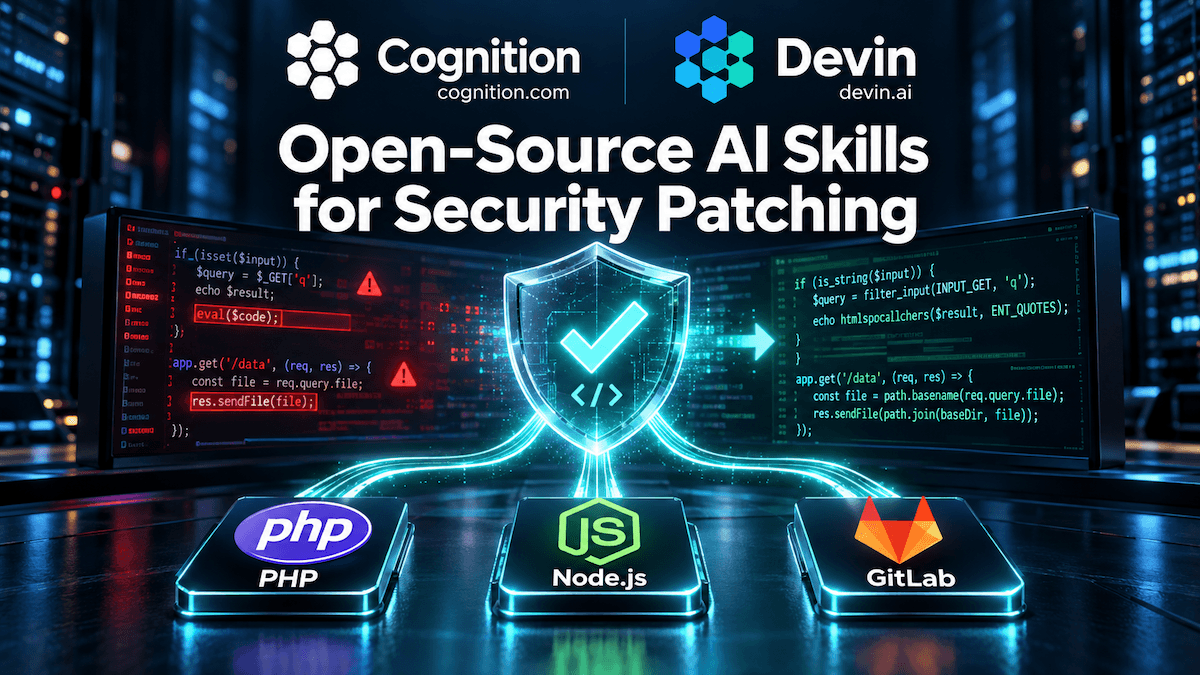
Cognition Open-Sources Devin Vulnerability Fixes plugins to Patch Critical PHP, Node.js and GitLab Vulnerabilities
Cognition Open-Sources Free AI Agent Skills to Patch Critical PHP, Node.js and GitLab Vulnerabilities
The past week was a rough one for anyone running web infrastructure. Three separate critical remote code execution (RCE) advisories landed almost back-to-back, hitting PHP, Node.js, and self-managed GitLab. Each one alone would justify an emergency patch window. Together, they leave small teams and solo founders staring at a long list of servers, containers, and CI pipelines, unsure where to start.
Cognition, the company behind the AI software engineer Devin, has responded with something unusual: it has given away the exact remediation workflow it used on its own systems. The Devin Vulnerability Fixes plugin is a free, open-source bundle of three agent skills, released under the MIT license, that guide an AI coding agent through finding and patching vulnerable deployments. And it isn’t locked to Devin. It runs in any coding agent that reads SKILL.md files.
What Cognition actually released
The plugin contains three skills, one per advisory:
fix-php-vulnfor the PHP2Shell vulnerabilitiesfix-node-vulnfor the Node.js October 2026 security releasefix-gitlab-vulnfor the self-managed GitLab flaw
Supported agents include Devin, Claude Code, Codex, Cursor, Factory Droid, GitHub Copilot, Gemini CLI, OpenCode, and Devin. To work, the agent needs Git, a shell, Docker, and access to your package or container registries.
The three threats it targets
PHP2Shell (CVE-2026-109618 and CVE-2026-109619). PHP scored both bugs 9.2 under CVSS v4.0. One causes memory corruption after an out-of-memory event; the other allows leftover global state from one request to bleed into the next. PHP considers every web-serving configuration exposed, with mod_php setups at greatest risk. Patched releases are 8.2.35, 8.3.36, 8.4.27, and 8.5.12. If you’re still on PHP 8.1 or earlier, there’s no official release for you, only source-level backports for 7.4, 8.0, and 8.1.
Node.js October 21 security release. This update closes 10 CVEs, four of them rated High. The most serious, CVE-2026-111497, is an out-of-bounds write in the Brotli decoder that could lead to code execution. Fixed versions are 22.23.4, 24.22.1, and 26.12.1. Node.js 20 and older are end-of-life and won’t receive a fix, so this is a good time to finally plan that upgrade.
GitLab CVE-2026-110264. This is the scariest of the three: a perfect CVSS 10.0. An integer overflow in GitLab’s regular expression compiler lets an attacker run code without logging in. It affects GitLab CE and EE going all the way back to version 7.0. If you use GitLab.com or GitLab Dedicated, you’re already covered. If you self-host, you need to act.
How the plugin works
What makes this release interesting isn’t just automation. It’s the discipline built into the process. Every skill follows the same five-stage flow:
Look, don’t touch. The agent first runs a read-only inventory across Dockerfiles, base images, OS packages, CI configs, Helm charts, Terraform, Packer templates, Lambda functions, and configuration management.
Wait for a human. No changes happen until you choose which repositories to patch. Riskier minor or major version jumps are flagged up front.
Verify the target. Every tag, image digest, package version, and checksum is checked against the official source before any file is edited.
Test twice. Your test suite runs on the current version, then again inside the newly built production image. If anything regresses, the run halts.
Ship one pull request per repo. Each PR documents the version changes, test results, runtime differences, a risk label, and a rollback plan.
The skills also bake in hard-won lessons about patching traps that trip up experienced engineers. Debian and Ubuntu often backport security fixes without changing the upstream version number, so running php -v can give you a false sense of being vulnerable or safe. On Ubuntu 24.04, for example, the patched package is 8.3.6-0ubuntu0.24.04.13. Images pinned by digest need a fresh digest, not just a new tag. And editing Composer’s require.php constraint does nothing to the PHP binary actually running in production.
Where it fits next to Dependabot, Copilot Autofix, and Snyk
It’s tempting to lump this in with existing tools, but it solves a different problem. Dependabot updates vulnerable libraries in your manifest and lock files. GitHub Copilot Autofix and Snyk Agent Fix suggest changes to your application source code. Cognition’s plugin works one layer down, on the runtime layer: base images, OS packages, and infrastructure-as-code. It’s also the only one of the four that insists on a read-only inventory and explicit approval before editing anything, and it’s fully free and open source.
In practice, these tools complement each other rather than compete.
How to install it
In Devin: go to Customize → Plugins → Browse Marketplace and search for “Vulnerability Fixes.”
Devin CLI:
devin plugins install CognitionAI/devin-marketplace#plugins/devin-vuln-fixesOther agents:
npx skills add CognitionAI/devin-vuln-fixes(requires Node.js 22.20 or later)Claude Code: add Cognition’s marketplace, then run
/plugin install vuln-fixes@cognition-skills
After that, you can simply tell the agent something like “fix my PHP vulnerability" or use the slash commands.
The limitations worth knowing
This isn’t a magic button. Cognition hasn’t published any benchmark or fix-success rate, so there’s no independent measure of how often it gets things right. Its safety net is your test suite. If your coverage is thin, the “test twice” step can’t catch much. Managed runtimes, appliances, and Electron apps are detected and flagged, but the plugin won’t patch them for you.
Why this matters for builders and small teams
For startups, indie hackers, and lean engineering teams, a week like this usually means dropping product work to chase CVEs across scattered infrastructure. A guided, approval-gated agent workflow can compress hours of manual auditing into a reviewable set of pull requests.
There’s also a bigger signal here. Agent skills are becoming a portable unit of expertise. Instead of a blog post explaining how to patch something, a company can now ship the procedure itself, ready for any compatible agent to execute. Expect more security vendors and platform teams to follow Cognition’s lead.
FAQ
Is the Devin Vulnerability Fixes plugin free?
Yes. It’s open source under the MIT license and free to use.
Do I need Devin to use it?
No. It works with any coding agent that supports SKILL.md files, including Claude Code, Cursor, Codex, GitHub Copilot, Gemini CLI, and Devin.
Which vulnerabilities does it cover?
PHP2Shell (CVE-2026-109618 and CVE-2026-109619), the Node.js October 21, 2026, security release including CVE-2026-111497, and GitLab CVE-2026-110264.
Will it change my code without permission?
No. It starts with a read-only inventory and won't make edits until you approve specific repositories.
What can’t it patch?
Managed runtimes, appliances, and Electron apps are flagged for manual handling rather than patched automatically.
The bottom line
Three critical RCE advisories in one week stress-test any team. Cognition’s plugin won’t replace good security practice, but it packages careful, test-verified patching into something any AI coding agent can run. If you self-host GitLab or run PHP or Node.js in production, patch now, whether you use this tool or do it by hand.
Have you tried AI agents for security patching yet? Share your experience with the community in the comments